



Blog
The Future of Security: How Technology is Transforming Protection Services :

Introduction
The security industry is undergoing a rapid transformation. Traditional guarding services are no longer sufficient to address the complex threats faced by modern businesses, residential communities, industrial facilities, and event organizers. Today, the future of security lies in the seamless integration of trained manpower and advanced technology.
From AI-powered surveillance systems to real-time remote monitoring and biometric access control, technology is redefining how protection services operate. Organizations are now looking for security partners who can deliver not just physical presence but also intelligent, data-driven protection strategies.
In this article, we explore how technology is transforming protection services and why integrated security solutions are becoming the new industry standard.
The Shift from Traditional to Technology-Integrated Security
For decades, security services primarily relied on physical guarding — trained personnel stationed at gates, entrances, and sensitive areas. While manned guarding remains essential, the security landscape has changed significantly.
Modern risks such as cyber-physical threats, organized theft, insider risks, and large-scale public events require more advanced systems. This shift has led to the adoption of:
- AI-based surveillance systems
- Smart access control solutions
- Remote monitoring centers
- Automated reporting tools
- Real-time communication platforms
The result is a more proactive and preventive security model instead of a reactive one.
AI-Powered Surveillance: Smarter Monitoring, Faster Response
Artificial Intelligence (AI) has revolutionized video surveillance. Traditional CCTV systems required constant manual monitoring, which often led to human error or delayed responses.
Today’s AI-powered CCTV systems can:
- Detect suspicious movements
- Identify unauthorized access attempts
- Recognize unusual behavioral patterns
- Trigger automatic alerts
- Store and analyze data for investigation
With intelligent analytics, security teams can respond to incidents in real-time rather than reviewing footage after an event has occurred. This drastically reduces response time and increases operational efficiency.
Remote Surveillance Monitoring: 24/7 Real-Time Protection
Remote monitoring has become a critical component of modern security solutions. Instead of relying solely on on-site personnel, centralized control rooms monitor multiple locations simultaneously.
Key benefits include:
- Continuous 24/7 surveillance
- Immediate incident reporting
- Reduced operational costs
- Centralized command and control
- Faster coordination during emergencies
For industrial facilities, warehouses, and large residential complexes, remote surveillance adds an extra layer of protection beyond physical guards.
Access Control & Biometric Systems
Unauthorized access remains one of the biggest security risks for corporate offices and industrial units. Modern access control systems provide secure, trackable, and automated entry management.
Popular technologies include:
- Biometric fingerprint scanners
- Facial recognition systems
- RFID access cards
- QR-based visitor management
- Digital entry logs
These systems not only enhance security but also provide accurate attendance tracking, visitor records, and access history for audit purposes.
Integrated Security Management Systems
The future of security lies in integration. Instead of operating separate systems for CCTV, access control, alarms, and manpower, businesses are adopting unified platforms.
An integrated security management system allows:
- Centralized monitoring
- Automated reporting
- Data-driven decision-making
- Coordinated emergency response
- Enhanced transparency
This structured approach ensures smooth operations and reduces the risk of miscommunication during critical situations.
Technology + Trained Manpower: The Perfect Balance
While technology enhances monitoring and detection, trained security personnel remain the backbone of protection services. The ideal modern security model combines:
- Professional guarding services
- Technology-integrated monitoring
- Risk assessment and planning
- Structured supervision
- Emergency response training
Guards equipped with digital reporting tools and mobile communication devices can respond faster and operate more efficiently.
Data-Driven Risk Assessment & Threat Analysis
Advanced technology allows companies to collect and analyze security data. This enables predictive security planning instead of reactive action.
Through risk assessment and threat analysis, organizations can:
- Identify vulnerable zones
- Understand peak risk timings
- Optimize guard deployment
- Improve security policies
- Strengthen compliance measures
Data-driven insights help businesses minimize risks before they escalate.
The Growing Demand for Event & VIP Security Technology
Large-scale events and VIP movements require advanced planning. Modern technology assists in:
- Crowd density monitoring
- Facial recognition for restricted access
- Drone surveillance for large venues
- Real-time communication networks
- GPS tracking for VIP convoys
These tools enhance situational awareness and ensure smooth coordination.
Cyber-Physical Security Integration
As businesses become more digital, physical security must integrate with cybersecurity measures. Access control systems, surveillance networks, and monitoring software are now connected to digital infrastructure.
Organizations must ensure:
- Secure network configurations
- Encrypted surveillance systems
- Controlled data access
- Regular system audits
The future of security is no longer limited to physical boundaries — it includes digital protection as well.
Why Businesses Must Upgrade Their Security Strategy
Modern threats demand modern solutions. Companies that continue to rely solely on traditional security methods risk operational disruption and financial loss.
Upgrading to technology-integrated security offers:
- Higher efficiency
- Better threat detection
- Improved accountability
- Stronger compliance
- Enhanced client confidence
A forward-thinking security strategy protects not only assets but also brand reputation.
Conclusion: The New Era of Intelligent Protection
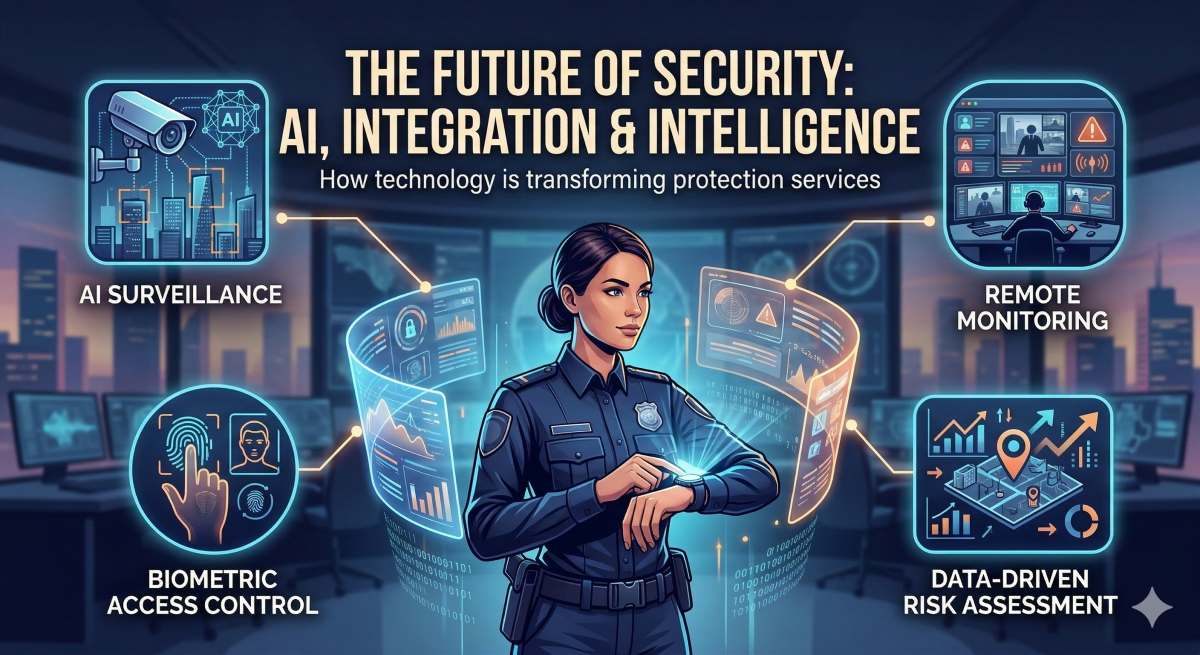
The future of security is intelligent, integrated, and proactive. Technology is not replacing security personnel — it is empowering them. AI surveillance, biometric access control, remote monitoring, and data-driven risk assessment are setting new industry benchmarks.
Businesses, residential communities, industrial facilities, and event organizers must embrace modern security solutions to stay protected in an evolving risk environment.
Technology-integrated protection services provide the structure, precision, and reliability required in today’s world.
As the security industry continues to evolve, one thing remains constant — the need for discipline, expertise, and innovation working together to deliver complete protection.